

Canada has long been a dream destination for many Pakistanis looking for better opportunities, a higher standard of living, and a peaceful environment. With its multicultural society, high-quality education, and excellent healthcare, Canada offers an attractive option for those seeking to immigrate. But how can Pakistanis apply for Canadian Permanent Residency (PR) in 2025? This guide will walk you through the steps, requirements, and strategies to increase your chances of success.
Introduction to Canadian Permanent Residency
Moving to Canada as a permanent resident is a significant decision, but the rewards are substantial. Permanent Residency allows you to live and work in Canada indefinitely, access healthcare, and apply for citizenship after a few years. For Pakistanis looking to apply for PR in 2025, it’s essential to understand the various pathways available and how to navigate the process.
Imagine it like boarding a train with multiple stations—Express Entry, Provincial Nominee Programs (PNPs), family sponsorship, and more. Each “station” represents a different route, and choosing the right one depends on your qualifications and circumstances.
Eligibility Requirements for Pakistani Applicants
Before applying, it’s crucial to ensure you meet the eligibility criteria. Canadian immigration is primarily skills-based, but factors like age, education, work experience, and language proficiency are key.
- Age: Typically, applicants between the ages of 18 and 35 receive more points.
- Education: A bachelor’s degree or higher is preferred. You must have your educational credentials assessed by an approved Canadian body.
- Work Experience: Skilled work experience in specific fields adds significant points to your application.
- Language Proficiency: Passing an English or French language test like IELTS is mandatory.
- Medical and Security Clearances: You must undergo a medical exam and provide police clearance certificates to prove you’re admissible.
These factors combined determine your Comprehensive Ranking System (CRS) score, which plays a vital role in certain PR pathways like Express Entry.
Express Entry System: A Popular Pathway
The Express Entry system is one of the most popular immigration pathways for Pakistanis in 2025. It’s fast, transparent, and based on points calculated using the Comprehensive Ranking System (CRS).
Here’s a brief breakdown:
- Step 1: Create an Express Entry profile online, where you submit your personal details, education, and work experience.
- Step 2: Get a CRS score based on the information you provide.
- Step 3: If you have a high CRS score, you may receive an Invitation to Apply (ITA) for PR.
- Step 4: Once you receive an ITA, you submit a full application for PR, including all necessary documents.
For those with a strong educational background and solid work experience, Express Entry is a relatively quick route to Canadian PR.
Provincial Nominee Programs (PNPs)
Not all immigrants qualify for Express Entry. But there’s another route: Provincial Nominee Programs (PNPs). Each Canadian province has its own PNP, allowing them to nominate candidates based on local labor needs. Some provinces, like Ontario, British Columbia, and Alberta, have high demand for skilled workers in fields like IT, healthcare, and engineering.
Here’s how it works:
- Step 1: Apply for a nomination from the province.
- Step 2: If you receive a nomination, you’ll get additional points added to your Express Entry profile, significantly increasing your chances of getting an ITA.
- Step 3: After the province nominates you, proceed with the federal PR application.
Each province has its own eligibility requirements, so you must research the best fit for your skills.
Family Sponsorship for Pakistani Applicants
Do you have family members who are Canadian citizens or PR holders? Family sponsorship is another pathway for Pakistani applicants.
Under this program, Canadian citizens or permanent residents can sponsor:
- Spouses or common-law partners
- Dependent children
- Parents or grandparents
Family sponsorship can simplify the process and doesn’t rely on the points system used by Express Entry. However, it’s crucial that the sponsoring family member meets income requirements and agrees to financially support you for a set period.
Canadian Experience Class (CEC)
For Pakistanis already living and working in Canada, the Canadian Experience Class (CEC) could be a direct route to PR. It’s designed for skilled workers who have Canadian work experience, usually gained through a temporary work permit or study permit.
Key factors include:
- Work Experience: At least one year of full-time (or part-time equivalent) skilled work experience in Canada.
- Language Skills: Proficiency in English or French.
- Education: While not a primary factor, education can strengthen your CRS score.
How to Apply: Step-by-Step Process
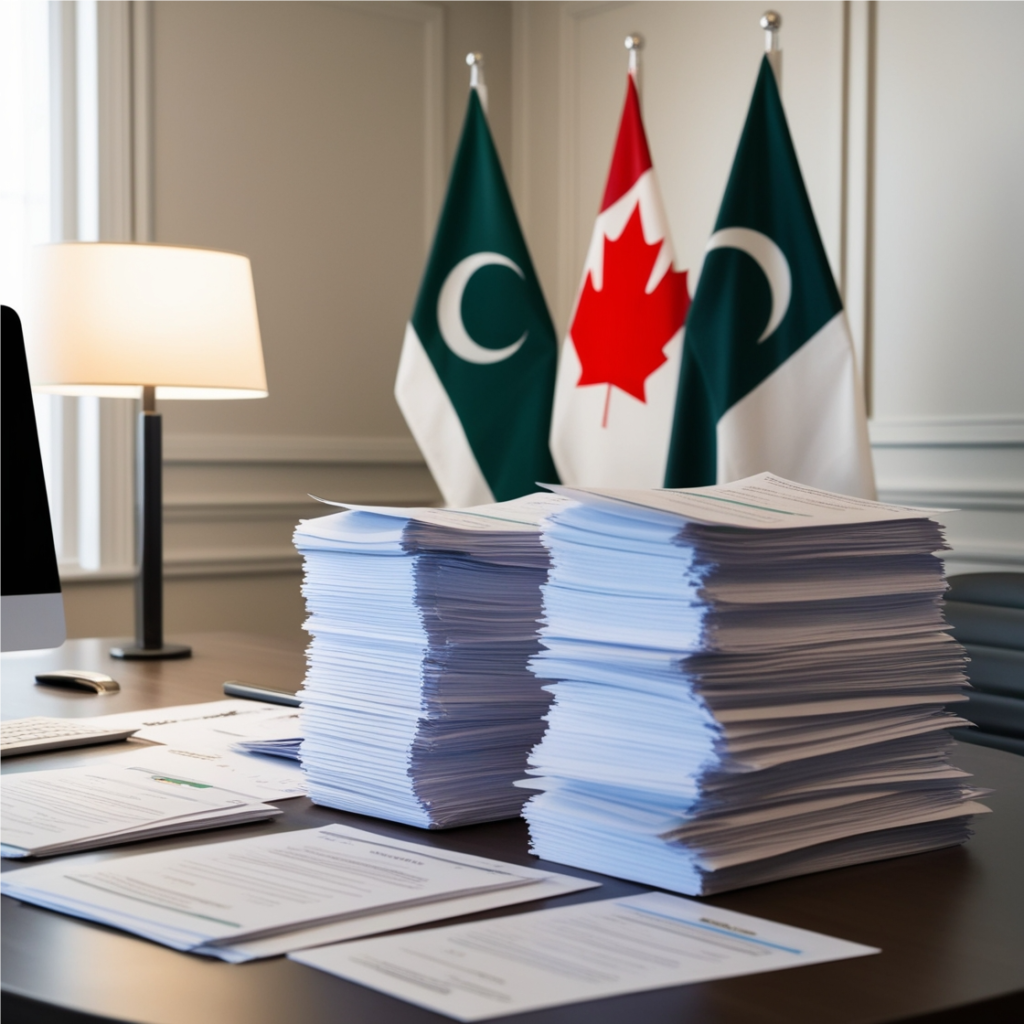
Applying for Canadian PR is a meticulous process, but it becomes manageable if you follow these steps:
- Determine Your Eligibility: Use online tools like the CRS calculator to estimate your score.
- Choose a Program: Decide between Express Entry, PNP, Family Sponsorship, or CEC.
- Gather Your Documents: Get your educational credentials assessed, take language tests, and collect work experience records.
- Create a Profile: Submit an Express Entry or PNP profile with accurate details.
- Wait for an ITA: If your CRS score or provincial nomination is strong, you’ll receive an ITA.
- Submit Your Application: Provide supporting documents like police certificates, medical exams, and proof of funds.
- Pay Fees: There are application fees involved, typically ranging from CAD 1,325 for a single applicant to more if you’re applying with a family.
Documents Required for the Application
Documentation is key in the PR process. Some of the essential documents include:
- Educational Credential Assessment (ECA): Proves your educational qualifications meet Canadian standards.
- Language Test Results: IELTS for English, TEF for French.
- Work Experience Letters: Must be on official letterhead and detail your duties.
- Police Clearance Certificates: From all countries you’ve lived in for six months or more.
- Proof of Funds: Bank statements showing you have sufficient funds to support yourself in Canada.
Ensure these documents are accurate and up to date, as even small errors can delay your application.
Cost of Applying for Canadian PR
The cost of applying for Canadian PR can add up, so it’s essential to budget accordingly. Here are some expenses to consider:
- Application Fees: CAD 1,325 for a single applicant.
- Language Tests: CAD 300 for IELTS or TEF.
- ECA Fees: CAD 200-$300 depending on the service.
- Medical Exams and Police Certificates: Approximately CAD 500 combined.
- Proof of Funds: You must demonstrate that you have enough savings, which varies depending on family size.
Tips to Increase Your Chances of Getting Canadian PR
Want to boost your chances of success? Here are a few key tips:
- Improve Your CRS Score: Take extra language tests to increase your score.
- Get a Job Offer: A valid job offer from a Canadian employer can add significant points to your application.
- Apply for PNPs: Even if your CRS score is low, a provincial nomination can elevate it.
- Study in Canada: Enroll in a Canadian educational program to gain Canadian credentials and work experience.
- Avoid Mistakes: Double-check all information in your application, as inaccuracies can lead to rejection.
Common Mistakes to Avoid
Many applicants fail to get PR due to common mistakes like:
- Inaccurate or incomplete documents.
- Missing deadlines.
- Failing to meet language requirements.
- Not submitting police or medical records on time.
Ensure you meticulously follow every step to avoid these pitfalls.
How Long Does the Process Take?
The processing time for Canadian PR can vary, but on average:
- Express Entry: 6 to 8 months after receiving an ITA.
- PNPs: 12 to 18 months depending on the province.
- Family Sponsorship: 12 to 24 months.
Processing times can fluctuate based on the number of applications and changes to immigration policies.
Life in Canada: What to Expect
Once you’ve obtained PR and moved to Canada, life will change dramatically. Canada offers a high standard of living, diverse cultural experiences, and ample opportunities for work and education. Healthcare is publicly funded, and education is highly regarded. However, adapting to the cold climate and finding a job in your field may take time, so be patient and proactive. Contact us